Problem
Faus Enginyeria is a small engineering firm in Borriana, in the province of Castellón: around five people who help homes and businesses use less energy. Each client brings a lot of different work: energy performance certificates, technical reports, savings studies, renovation grants and Energy Savings Certificates (CAE, Spain’s white certificates). Their website mentions more than 700 Next Generation EU grant applications handled.
It all starts with a site visit. The technician goes over the house: its orientation, the windows, the insulation, the building services, the measurements. And writes it all down in a notebook. Back at the office, all of it then had to be written up: typing out the notes, downloading the photos, filing them away. Hours for every visit.
Everything else was scattered. Excel sheets that cross-referenced each other and had become impossible to maintain, folders full of loose files, Word templates filled in by hand, invoices here and there, and the accounts somewhere else entirely. And every new client was set up by one person, one email and one form at a time. The more clients came in, the bigger the pile grew. Hours of repetitive admin instead of engineering.
So the question is: how can a small team spend its time on engineering rather than paperwork?
Constraints
- A single platform. Clients, homes, jobs, documents and accounts all had to live in the same place, with what’s done and what’s still missing clear at a glance. Five different places are five places for something to get lost.
- A person always reviews. A certificate or a report goes out under the firm’s signature. Automation prepares the work, but someone checks it before anything goes out.
- The visit can’t stay on paper. The data and photos are collected at the home, and they need to be ready to use there and then, with nothing to write up afterwards.
Approach
My job was to design and build Enerforge from start to finish: a web platform, with its backend, where everything lives. Every client has a record with their home, every job done for them, their documents and where each thing stands.
On top of that foundation, each part of the work went from a chain of manual steps to a fixed workflow. On four fronts:
- Client onboarding. Before, one person gathered the client’s details by email, opened the templates, filled each one in, sent them off, and then sorted, renamed and logged whatever came back. Now, from the client’s details, Enerforge generates the paperwork and emails it out for signature. Whatever comes back is read by AI, which sorts it against the documents expected from that client, checks it and lets the office know whether everything is in order or something is missing. In the time it used to take to prepare one client by hand, many more requests now go out, almost instantly.
- The site visit. The technician still goes over every detail of the house, but now with a mobile app connected to the same cloud as the platform. Data and photos go in on the spot, organised in the client’s record and ready to use. There’s nothing left to write up.
- The engineering. Calculations, energy certificates, savings studies comparing different states of the home, reports and comparisons. Much of it was the same work, repeated by hand for every house. Now these are fixed workflows that produce the results and reports from the data already in the record, with a person reviewing at every key step.
- Invoicing and accounts. Before, it was hard to tell for each client what had been done, what was still to do and what it all cost. Now every job sits in the record with its cost, the invoice is issued and emailed automatically, and it’s always clear what’s been paid, what’s owed and what’s pending. And since every client is in there, the platform keeps the books for the whole firm: profit by type of job, expenses and accounting.
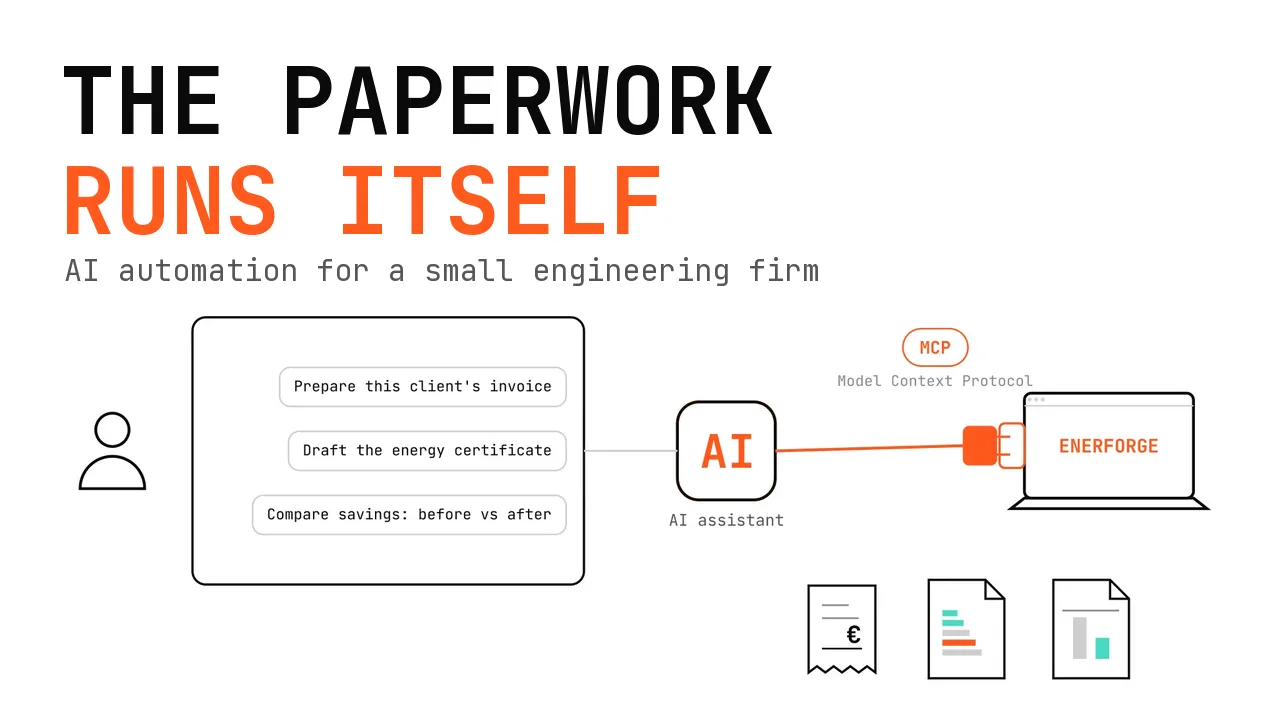
Enerforge also has an MCP server (Model Context Protocol), a standard way of connecting an AI assistant to a company’s own tools. With it, the Faus team can ask for work in plain language: prepare this client’s invoice, do the energy certificate for this home, compare the savings before and after the renovation. The AI does the groundwork on the platform, using the client’s real data, and a person reviews it. Faster, but never on its own.
Result
Enerforge is up and running at Faus Enginyeria. Everything that used to be spread across five places now lives on a single platform, and every step of the work, from the first call to the final invoice, is logged in the client’s record.
- Onboarding, which used to be a chain of manual steps, now runs by itself. The paperwork that comes back is sorted and checked by AI.
- Site visits no longer need writing up: the data and photos are in the record from the outset.
- Certificates, studies and reports are produced from the data already there, with human review at every key step.
- Invoices go out automatically for every finished job, and the firm’s accounts are always up to date.
What really changes is where the time goes. The repetitive part shrinks, and that time goes back into engineering, which is what brings value to the client and what earns the firm its money. That way, the same small team can take on much more work.
The paperwork runs itself. The engineers get to be engineers again.
Stack and deliverables
- Web platform Clients, homes, jobs, documents and accounts, all in one place.
- Automated workflows Onboarding, paperwork, certificates, reports and invoices, with human review.
- Site visit app Data and photos from the home, straight into the client’s record.
- AI and MCP server Sorts and checks incoming paperwork, and takes requests in plain language.
Where this fits
Many small firms live on the know-how of their people, yet lose a good part of the day to paperwork: copying data from one place to another, filling in templates, chasing documents and invoices. Off-the-shelf tools only go so far, because every company has its own way of working, and AI on its own, without access to the company’s data, never gets beyond a chat.
Filling that gap is what I do: understanding how the company works, bringing its data together on a single platform and automating the repetitive work, with AI where it helps and a person reviewing where it matters. It’s not about replacing anyone. It’s about making sure everyone’s time goes into what really adds value.